
Writing Tasks That Actually Prepare Students for GCSEs (Focus on Higher) - Not Just Fill Time

Let me be honest about something. I spent years setting writing tasks that were, in hindsight, busywork dressed up as learning. Fill in the gaps. Copy the model answer. Write five sentences about your family using the sentence starters on the board. Students were writing. Pens were moving. The room was quiet. It looked like learning.
It wasn't.
The problem only became clear when I started reading the new GCSE German specification carefully - not just skimming it, but actually sitting with the mark schemes and the sample papers and asking myself: What does this genuinely reward? The answer changed how I plan KS3 writing tasks entirely.
What the new GCSE actually asks students to do
The new specification's Paper 4 (Writing) is worth 25% of the GCSE and has a clear hierarchy of demand across Foundation and Higher. Understanding that hierarchy is the starting point for meaningful KS3 preparation.
At Foundation, students respond to a photo in four or five (exam board depending) short sentences (Question 1), then produce approximately 40-50 words covering compulsory bullet points (Question 2), complete produce approximately 80-90 words covering compulsory bullet points (Question 3), and complete a translation task - individual sentences (Question 4). It is structured, scaffolded, and tests whether students can communicate accurately within tight constraints.
At Higher, the demands shift significantly. Question 1 asks for around 90 words across compulsory bullet points. But it is Question 2/3 (exam board depending) - the more open-ended task worth the most marks - that is the real differentiator. The specification describes it explicitly as a task that demonstrates students' ability to make "more creative use of the prescribed vocabulary and grammatical structures, showing a higher level of complexity and accuracy." Students choose from two options and write approximately 150 words. Equal credit is given for language that goes beyond the defined vocabulary list. The mark scheme rewards communication, range, and accuracy together.
That word 'creative' matters. It is not decoration. It is in the specification. And if we want students to be ready for it, we need to be building creative writing habits from Year 7.
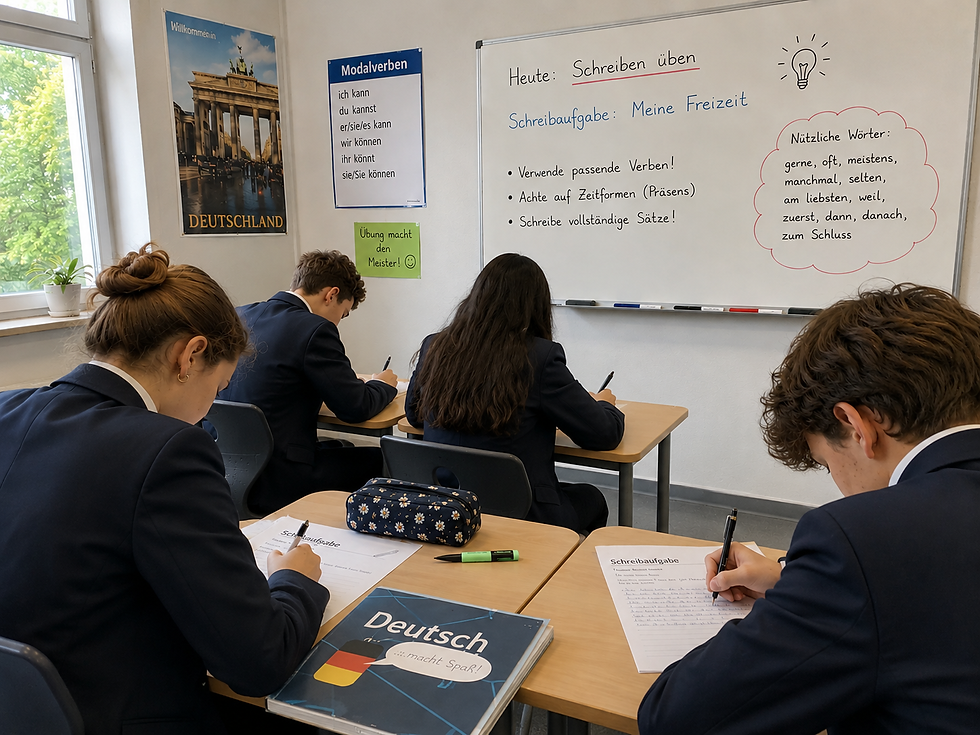
What "creative" actually means in this context
When the specification uses the word creative, it does not mean surrealist fiction or abstract poetry. It means the ability to go beyond the prompt - to add detail that was not asked for, to choose vocabulary deliberately, to construct sentences that do more than one thing at once, to write with a voice rather than just with accuracy.
A student who writes: "Ich war in Berlin. Es war schön. Das Hotel war gut. (I was in Berlin. It was nice. The hotel was good.)" is not being creative. A student who writes: "Obwohl die Jugendherberge kleiner als das Hotel war, hat sie mir viel besser gefallen, weil sie zentraler lag und die anderen Schüler sehr freundlich waren. (Eventhough the youthostel was smaller than the hotel, I liked it much better as it was located more centrally and the other students were very friendly.)" is. Both might be grammatically acceptable. Only one is going to access the top band.
The difference is not ability. It is habit. Students who have spent KS3 practising writing that goes beyond the minimum, that adds opinions, comparisons, justifications, time references, find the Higher creative task more natural. Students who have spent KS3 copying model answers find it terrifying.
Start with purpose, not with language
The single biggest shift I made was to stop starting lesson planning with "What vocabulary do we need to cover?" and start with "What would a real person actually do with this language?"
Take a Ferien (holidays) unit, a staple of Year 8 schemes of work and one of the three GCSE themes (Travel and tourism / Communication and the world around us). The traditional writing task used to be: Write about a school trip. Use variety of tenses and language. Aim for 80 words. Students produce something technically acceptable, completely lifeless, and entirely disconnected from any real communicative purpose.
Compare that with: Write a blog post for the school website about your holiday to Berlin. You want to persuade next year's students to go. Include what you did, what was better or worse than you expected, and what you would recommend. The language targets are identical. But now students have a reader, a purpose, and a reason to make choices. They need to persuade, not just report. They need to compare, not just list. They need to recommend, not just describe.
This is directly relevant to GCSE Higher Question 2 or 3 (exam board depending), which will always involve a communicative frame: a blog post, an email, a letter, an article. Students who have practised writing for audiences throughout KS3 will find the framing of the exam task familiar. Students who have only ever written generic paragraphs will not.
Build the three time frames from the start - seriously, from Year 7
One of the strongest predictors of whether a student will access the higher GCSE bands is whether they can move fluently between past, present and future within a single piece of writing. This is not a Year 10 fix. It needs to be built from the moment they start the language.
In Year 7, even with minimal German, students can write three sentences: Ich fahre mit dem Bus zur Schule. Es war früher ziemlich schnell./ Ich hatte tolle Zeit. Morgen fahre ich mit dem Fahrrad./ Morgen werde ich mit dem Rad fahren. It is simple. It is clunky. But it establishes a habit; the habit of thinking across time frames that pays enormous dividends by Year 11.
By Year 8, I frame every significant writing task around all three explicitly. For the Holiday unit, the planning grid has three columns: Normalerweise / Präsens - In den Ferien/ Vergangenheit - Nächstes Mal / Zukunft. Students fill in the grid first, in note form, before writing a single sentence of German. Then the piece becomes a matter of translating their plan into language they already know.
The planning grid is not just a scaffold - it is building the metacognitive habit of thinking about time frames before writing and allows students to get used to the questions. By the time students sit in the exam hall, that planning instinct is automatic.
German example
Normalerweise / Präsens | In den Ferien / Vergangenheit | Nächstes Mal / Zukunft |
Wohin fährst du normalerweise? | Wohin bist du gefahren? | Wohin wirst du nächstes Mal fahren? |
Mit wem fährst du normalerweise? | Mit wem bist du gefahren? | Mit wem wirst du fahren? |
Was machst du normalerweise? | Was hast du gemacht? | Was wirst du machen? |
Wo wohnst du normalerweise? | Wo hast du gewohnt? | Wo wirst du wohnen? |
Was isst du normalerweise? | Was hast du gegessen? | Was wirst du essen? |
Wie ist das Wetter normalerweise? | Wie war das Wetter? | Wie wird das Wetter sein? |
Meinung + Begründung | Meinung + Begründung | Meinung + Begründung |
English example
Normally / Present | On Holiday / Past | Next Time / Future |
Where do you normally go? | Where did you go on holiday? | Where will you go next time? |
Who do you normally go with? | Who did you go with? | Who will you go with? |
What do you normally do on holiday? | What did you do? | What will you do? |
Where do you normally stay? | Where did you stay? | Where will you stay? |
What do you normally eat? | What did you eat? | What will you eat? |
What is the weather normally like? | What was the weather like? | What will the weather be like? |
What do you think about it? Why? | What did you think about it? Why? | What will you think about it? Why? |
Example of notes:
Normalerweise / Präsens | In den Ferien / Vergangenheit | Nächstes Mal / Zukunft |
Spanien | Österreich | Deutschland |
mit meiner Familie | mit Freunden | mit meiner Schwester |
schwimmen | wandern | Ski fahren |
im Hotel | auf einem Campingplatz | in einer Jugendherberge |
Pizza und Eis | Schnitzel | Currywurst |
sonnig und heiß | kalt aber schön | hoffentlich warm |
entspannend | fantastisch | aufregend |
These notes become the springboard for sentence writing. Starting with simple structures, students are guided through modelling to gradually extend and add complexity to their sentences.
Use comparatives deliberately - they are a creativity marker
The new specification rewards range. Comparatives are one of the most accessible ways to demonstrate range, and they are badly underused below Year 10.
In a unit on accommodation - hotels, youth hostels, campsites, I build in a writing task that requires comparison explicitly. Not just 'Ich mag die Jugendherberge (I like the youth hostel)' but 'Die Jugendherberge war zwar kleiner als das Hotel, aber sie war billiger und moderner, und es gab mehr Möglichkeiten, andere Schüler kennenzulernen' (The youth hostel was smaller than the hotel, but it was cheaper and more modern, and there were more opportunities to get to know other students.)'. Students are using comparatives, concessive clauses, and justifying opinions - all of which the mark scheme credits as evidence of complexity and range.
The key is making the comparison non-optional. If the task says "write about accommodation", students default to simple statements. If the task says "you and your partner disagree about where to stay on next year's class trip- write an email arguing for your choice", students have to compare. The task design forces the grammar without it feeling like a grammar exercise.
This maps precisely onto the kind of creative language use that GCSE Higher Question 2/3 rewards. A student who has practised making arguments in German using 'obwohl, weil, trotzdem, zwar...aber', will reach naturally for those structures in the exam. A student who has only ever used 'weil' in isolation will not.
Teach the text type, not just the content
Here is something we do not always make explicit: different text types have different conventions, and writing with awareness of those conventions is part of what the mark scheme rewards.
In a Holiday unit, the natural writing task is a blog post. But before students write anything, I spend time looking at what a blog post actually does. How does it open? Does it address the reader directly? How does it end? What verb tenses appear and when? What connecting phrases give it a sense of voice?
I give students a model blog post - not to copy, but to analyse. We look at how the writer uses the Perfekt to narrate what happened, the Präsens to give current opinions, and the Konjunktiv II or future to say what they would do differently. We notice that a strong blog post does not just list events chronologically. It has a perspective. It makes comparisons. It concludes with something that invites the reader in.
Then students write their own. They are not working from nothing - they have vocabulary, a sense of the text type, a communicative purpose, and a model to diverge from rather than copy. That is the creative space the new GCSE is trying to open up.
Example of a blog for analysis


A text analysis task like this one can then be used alongside the activity:

Feedback that builds writers, not just corrects errors
I used to cover student writing in red pen. Error corrected, grade given, move on. The problem is that correction does not teach writing; it just identifies what went wrong after the fact.
Two strategies that have genuinely changed how my students improve:
Coded feedback. Instead of correcting errors, I mark them with a code: T for tense, WO for word order, G for gender, Sp for spelling etc. Students then correct their own work using the code as a guide. Students who correct their own errors remember the rule. Students who copy my correction into the margin do not.
Improvement drafts. Every significant piece of writing gets a second draft. Not a rewrite from scratch - students take their original piece, read the feedback, and write a second version in a different colour. The comparison between the two drafts is visible, and students can articulate what they changed and why. This is exactly what happens in the planning and checking stage of a GCSE exam - except by then, it needs to be internal. Building the habit early makes it automatic later.
An example of a task


The GCSE question to ask yourself about every writing task
Before I set any writing task now, I ask one question: Could a student complete this task without using the language I want them to practise?
If the answer is yes, redesign the task. A student who is asked to "write about their weekend" can get by with five recycled verbs and no opinions. A student asked to "write a blog post reviewing a restaurant you visited, comparing it to somewhere you have been before, and recommending it to a specific type of reader" cannot.
Good writing tasks, like good GCSE exam questions, have just enough constraint to push students towards the language you need, and just enough freedom that the writing still feels like genuine communication.
A note on frequency
Students need to write more than we think. Not necessarily longer tasks, but more frequent ones. A focused ten-minute writing task at the end of three lessons a week is worth more than one extended task per half-term. Frequency builds fluency. Regularity builds habit. Low stakes mean students are more willing to take risks, to attempt a subordinate clause they are not certain of, to use a word they have only seen once, to write a sentence that does two things at once.
That kind of 'safe'(because it has been practised over and over) risk-taking is exactly what the new GCSE Higher Question 2/3 rewards. The specification says explicitly that credit is given for language beyond the defined list. A student who has spent three years playing it safe, recycling the same structures, will not suddenly become bold in a Year 11 exam. A student who has spent three years being encouraged to reach a little further with every piece of writing very well might as they will have that knowledge to do so.
By the time they walk into the exam hall, writing in German (French, Spanish etc.) should feel normal. Not special. Not frightening. Just something they do, and something they can do creatively.


Comments